What You Want vs. What He Hears

Maybe you feel like you've complained to your husband until you're blue in the face asking for something specific to happen. It's crystal clear to you that what you want is obvious.

First, I want to tell you that you aren't alone.

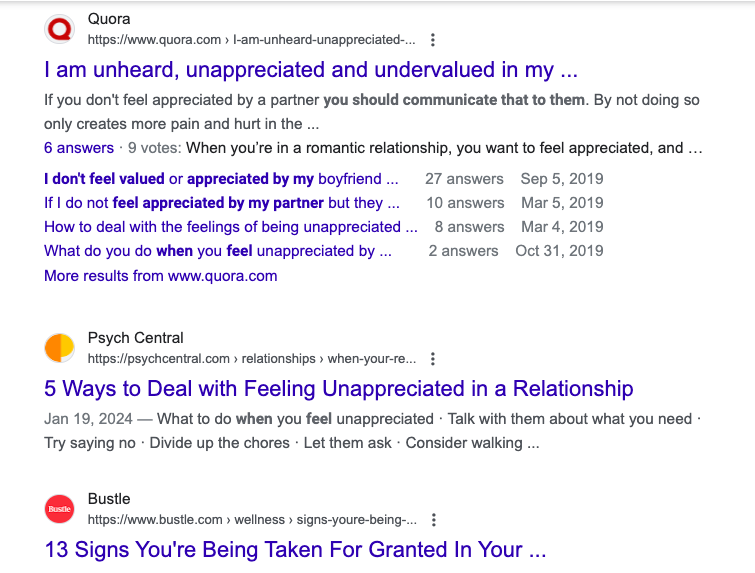
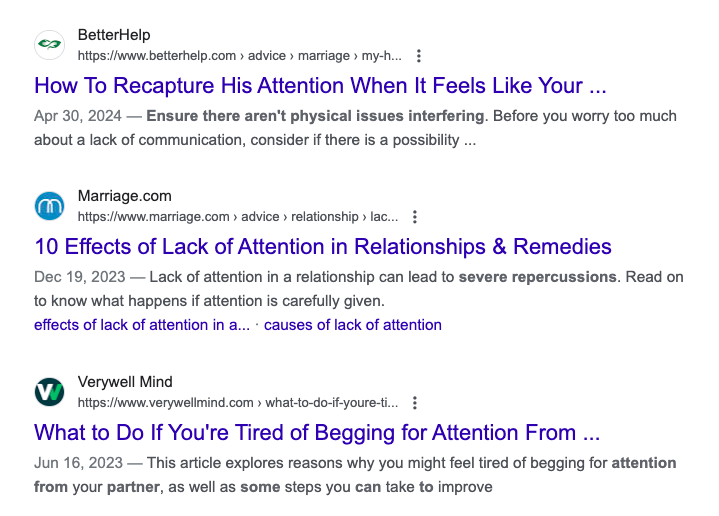
You can probably google your issue and find thousands of other wives with the same issue. 

(see images below using some of these phrases) 

"Husband doesn't show me any attention after work"
"I don't feel appreciated by my husband."
"I feel like my husband doesn't help enough with household chores" 
"My Muslim husband doesn't plan anything special for me"

I share this often with my coaching clients to offer them assurance that while things are difficult, they aren't the first and insha'Allah things can improve in time with better tools and techniques. 

So what options do you have?

What's Within Your Control

1) Focus on Being Specific About Actions You Want

"I don't want to tell him what to do! He's a man, he should be able to figure it out!"

I hear this often from my coaching clients (specifically the wives) and I understand the sentiment behind it. You want to be taken care of, to feel loved, and to see your husband do the mental work to determine how to make you happy.

How many years have you been saying this though? If it's not working out for you, and you're just increasing in feelings of resentment, it's time for a different plan.

When you tell your husband what you need in terms of the action you are looking for his brain can grasp what meeting your need actually looks like. Otherwise, he might do his own guess work, and still fail because he didn't do the right action you wanted. 

Let's practice asking for an action that's specific.

"I want you to help more around the house!" --> "I'd like you to do the night routine with the kids while I load the dishwasher and finish the kitchen in peace."

"I want you to be more available for us as a family." --> "I'd like a set time each day and weekend to look forward to as family time where you are fully available to connect with."

"I'm tired of how often you cave into your mother's requests for us to come over. We never go out as a couple!" --> "I miss you. I want you to see your mother and I also need time alone with you to build our romantic connection. How can we schedule a block of time for just us each week?"

2) Understand What He Hears

When a wife is trying her best to share her hurt, disappointment, and needs, she may miss that how she is expressing herself isn't allowing him to actually know what the solution is. 

What you think you're sharing are requests but what he is probably hearing is vague ideas wrapped up in criticism. The more grounded he is as a man the better he can take the hit and still respond with love.

But a lot of men don't know how to listen without getting defensive when they are feeling attacked. Rather than being upset about that, work with it. 

What they hear...

"You never spend time with me..." (you're awful)
"I'm always the one to do everything around here..." (you're worthless)
"I never get to do something just for myself..." (you're selfish) 
"You go out with your friends and I'm always stuck with the kids.."(you're a jerk)
"When's the last time you said something nice about me?" (you're heartless)
"You never respect my feelings when I express myself." (you're a jerk)

HANG ON!!!!! 

I know a lot of women would jump in right here and say "Megan, if my husband said these things to me I'd take it seriously and change! I would ask more questions and seek to understand him. I'm the one always taking seriously his needs but he doesn't do the same for me.

Maybe.

Or maybe some of you would be just as defensive if things were turned around.

Let's try a few....

"You never keep the house consistently organized and clean."
"I'm the only one who has to worry about our budget and earning money."
"I never get time to myself after working all day."
"I don't have a single hobby for myself - I'm always trying to do stuff for the family."
"You rarely make me feel desired as a man or initiate intimacy."
"You never respect my feelings when I express myself."

I don't know about you but I think I'd feel pretty defensive with statements like this. The first thing your brain would do is try to prove how and when these statements haven't been true. 

And that is the beginning of a fight going nowhere...

If you pay attention you can now see there aren't any actionable requests. 

When you work with specific requests a much better conversation can be had because of the following:

1) the exact action you imagine would be a solution is on the table
2) discussing alternative actions can be discussed until a win-win is found 
3) there is no mind reading expected to magically figure out what to do
4) you are accepting with maturity that if your husband knew what intuitive action he should be doing - he would have done it. (and viceversa)
5) you are inviting teamwork vs. staying angry & alone while not speaking up.
 

Recommended Program
"How to Fight Less & Love More" 
Learn More

Unspoken Heartache: Ramadan & Your Marital Relationship

Unspoken Heartache: Ramadan & Your Marital Relationship
By Megan Wyatt, Founder of Wives of Jannah


Ramadan is a blessed time of the year. It is the month the Holy Qur'an was first revealed to our beloved Prophet Muhammad, sallalahu alayhi wa sellum.

It is a month of spiritual purification and discipline through fasting. 

It a month where we seek out Laylatul Qadr, a night hidden on the odd nights of the last ten nights, where we seek the company of angels, the answering of our du'a, and to seek the forgiveness of Allah, subhanahu wa ta'ala. 

It is a month where our goal is to increase our acts of worship knowing each action is increased in reward and to come closer to our Lord and our purpose for this dunyah. 

It's a month of generosity in providing food for others to break their fast, charity for those needing a hand, and a time encouraged to forgive others and cleanse our hearts of grudges.

Ramadan is also, from my experience working with wives and couples over the last thirteen years, also a month that can increase tension between a wife and her husband.

How is it possible that this month filled with so many reminders and so many beautiful acts of worship can increase heartache? I'd like to address a few common issues and some solutions to help this month go more smoothly. 


1:
Accepting Ramadan isn't going to change long-standing issues.

Ramadan isn't going to make long-standing marital issues magically disappear.

Long-standing issues need to be addressed formally, out in the open, and worked on over a period of time.

I've heard the heartache in a wife's voice when she would say to me, "How could my husband do something like this even in the month of Ramadan!"

You and your husband are human beings who do not transform when Ramadan begins.

On the contrary, Ramadan is intended to be a month-long exercise in spiritual development. We don't become angels when the month begins. Instead, we recognize how much of ourselves needs to be refined and worked on as the month progresses.

The blessed month of discipline and deprivation of food, drink, and intimacy in the daylight hours offers us an opportunity to increase our ability to tolerate distress, discomfort, and dig deep into our spiritual beliefs regarding self-control, disciplining our nafs, and personal muhasabah (accountability) of our actions.

Optimistically, knowing that we are to control even our temper while fasting could certainly be the reset and reminder needed for a couple as they recognize they do have the ability to maintain greater self-control and manners around each other. 

Generally speaking, however, whatever needs addressed before Ramadan will still need to be addressed during and after. Don't set yourself up for the expectation that anything will be dramatically different.

Embracing where things are at can allow you to be strategic in how you approach this month insha'Allah. 

2:
Focus on what is within your control and sphere of spiritual development.


Ramadan reminds us that Allah, subhanahu wa ta'ala, is Rabil 'Alameen. We are His slaves in need of Him and without Him we cease to exist. To Him we bring our needs, heartaches, and goals in the form of our personal du'a.

When it comes to marital challenges it's important to take a moment and ask yourself what is solidly within your personal control. 

The time in Ramadan is precious. You don't want to waste time or emotional or physical energy, on things you cannot change or in arguments that always yield the same result. 

During this month, I encourage you to put on pause things that are beyond your control. 

Instead, focus on yourself and maximize your time for your own benefit. 

Focus on your spiritual development, refining your character, and being the Muslimah you want to be for the sake of Allah. 

Not easy to do when you're being tested in your marriage is it? 

But remember; this entire dunyah is a test of your iman. Your marriage isn't outside of those tests nor are those tests something special only you are going through. 

All relationships are a test in some capacity. 

Use yours to go inward and challenge yourself to focus on what is fully within your control and leave to Allah what isn't. 

To be clear this doesn't mean ignoring your hurt feelings or losing your backbone. 

"A question that can help you shift back into a place of empowerment is this:
"If the problem you are focused on was immediately solved, what would you spend your time doing instead of thinking about the problem or engaging in it?"


You can absolutely say, for example, "What you just said hurt my feelings," or "I'm feeling hurt and unheard so I'd like to discontinue speaking for now." Sharing your feelings and setting boundaries that advocate for your well being is part of a healthy marriage. But it does mean redirecting your focus to yourself and, again, focusing on what is within your control. 


Sharing your feelings, as an example, is something you can control. How your husband reacts you cannot. Sharing your personal boundaries is something within your control. Whether or not your husband will honor them is not.

A question that can help you shift back into a place of empowerment is this: "If the problem you are focused on was immediately solved ,what would you spend your time doing instead of thinking about the problem or engaging in it?"

3.
Choose to act with rahmah when the mouada feels faint. 

Abu Huraira reported: The Messenger of Allah, peace and blessings be upon him, said, “When Allah completed the creation, He wrote in His book with Him upon the Throne: Verily, My mercy prevails over My wrath.” (1)

Bring this concept into your marriage as much as you can (keeping in mind what I mentioned before about healthy boundaries.) 

Acting with rahmah, or mercy, means that you focus on taking the high road and giving your best self to your spouse even if you feel they don't deserve it.

Being merciful is a choice you make because it reflects the kind of person you want to be.

When feelings of mouada (love) are low it's encouraged to maintain a relationship and act according to rahmah (mercy.)

I would argue that mercy includes behaving respectfully, kindly, and being considerate in situations that tempt you to do the opposite.

You aren't always going to like your husband. You might argue that deep down you love him but on some days you may just not really like him! I say this with a touch of humor but also honestly. 

When you live day in and day out with any human being there are going to be moments you just don't really like them. It's normal but it's equally important you choose who you want to be during those moments or periods of time. 

How you conduct yourself is part of what you are held accountable for with Allah.

During a month where there is a little more exhaustion, busyness, and challenges of fasting and late night prayers a dose of mercy can go a long way in your relationship.

4.
Discuss your Ramadan schedule to examine stressors ahead of time. 

We are encouraged to do as many good deeds as we can in this month but honoring your marital and family commitments are also good deeds too.

A husband praying tarawih every single night and being gone for hours for an entire month leaving a wife home with a baby and young kids to clean up after cooking iftaar after her own day of fasting while also trying to pray extra on her own is not a necessary stressor.

Unfortunately, many cultures have given men a free pass in Ramadan to disappear after iftaar assuming that women are some kind of second-class worshippers who aren't due the same opportunities in the month as the men are. 

For those living near a masjid, the five daily prayers in jama'a for a man would be fard.

After this, everything is recommended and not required. Serving your family and supporting one's family is required.

Which means having a frank conversation about your needs as a wife and family is fair and necessary.

Otherwise, many wives express deep resentment towards their husbands and end up feeling that they matter less to Allah than men. This couldn't be further from the truth! 

I remember one year hearing a local imam address this in tarawih prayers. He reminded the husbands that tarwawih wasn't fard and to take turns with their wife if there were kids present. 

He encouraged the husbands to pray four rakat and then watch the kids while she prayed four rakat in peace. It was a beautiful example of love in action and an example of wanting for your spouse what you want for yourself. 

Other leaders remind husbands to help their wives clean up after iftaar so the whole family can make it to the masjid if this is the goal (which is common in Western Muslim communities.) 

One of my teachers would come and pray a few rakat of tarawih in congregation and then head home to lead his wife and kids at home. 

The change in schedule and the natural stressors it can cause can be discussed so that you and your husband are both on the same page. 

Knowing your own personal goals and limits is important too. Knowing what is too much for you and expressing that is important. 

Feeling resentful, neglected, and alone during this month should not be the outcome of a month of increased worship! What an irony, right? 

Couples can avoid this with open and supportive dialogue regarding each other's goals.


5.
Stop putting yourself last.
Take time for yourself to plan out personal Ramadan goals.  

The feminine, by default, is a nurturing and collective energy. Women are naturally more adept at keeping a pulse on what is happening in the family, what everyone is going through and needing, and organizing the family calendar.

Our greatest gift is our ability to give so much to those we love and care about. 

Coincidentally, one of our weaknesses is taking time for ourselves to nurture our own spiritual, emotional, physical, and psychological well being. 

"I feel so guilty...." is an oft-repeated phrase by many women even when their husbands are incredibly supportive of their wives goals! 

I used to wing Ramadan goals because I didn't take time to think about what was really important for me though I was on top of meal planning for iftaar, arranging iftaar invitations, activities and crafts for my kids, decorating, etc. All of these are valuable to me but they aren't what my own soul and heart need for development and growth. 

This is one reason why I am hosting a pre-Ramadan workshop with my dear mentor and friend Hosai Mojaddidi.  The goal is to help me, and those who participate, have a gentle on-ramp to prepare our hearts and minds for Ramadan. If you'd like to join us, click the link above or image for more details. 

If not, I encourage you to spend one hour thinking about Ramadan and taking time to allow your mind to slowly focus on what is coming up and decide what your few simple, tangible, and meaningful Ramadan goals will be. 

May Allah allow us to live for another Ramadan and be amongst those whom Allah loves in this dunyah and in the akhirah. Ameen. 

Building Back Your Self Confidence


Building Back Your Self Confidence 
by Megan Wyatt, Founder of Wives of Jannah 

Honestly, I think us females are just so hard on ourselves! We truly are!

So many women express the feeling that they've lost themselves after marriage and starting a family. That academic go-getter girl who had big dreams before marriage is now the go-fold-another-pile-of-laundry woman who dreams of a crumb free floor, empty laundry basket, and a chance to sit down and drink from her favorite mug in silence. 

Goodness. So many of us just want silence. Not diamonds and bigger houses. Just silence! But so many of us also desire....more. To see more of ourselves realized and to feel confident in our abilities to participate in the world at large. 

As a wife and a mother of four, alhamdulilah and masha'Allah,  I completely understand the desire for silence, to see the bottom of my laundry basket, and to connect with parts of myself that go beyond my family and home.

Saying this out loud is often scary for women who fear it makes them sound ungrateful or uncaring about their families.

But it doesn't have to be this or that.

You can be a fully dedicated wife and mother and also dedicate yourself to areas of your life that truly nurture you and make good use of your talents and abilities.

Before I discuss self-confidence it's worth nothing that the phrase "self-confidence" and "self-esteem" are often interchanged but they focus on different parts of ourselves. 

"The terms self-confidence and self-esteem are often conflated. Confidence is a measure of faith in one’s own abilities; esteem is about our sense of self. It involves both thoughts and emotions and influences how we perceive others and interact with the world." (1)

In another post I'll talk about self-esteem but today let's look at building back your self-confidence without compromising your family life. 


1) Make peace with prioritizing your family.

I am completely unapologetic about the fact that I only coach clients on Sundays.  This is because being present with my husband and my kids is a top priority in my life. Each of my children, ranging in ages from 18-6 need a part of me each day.

I homeschool the younger two (and used to homeschool the older two) and spend a good part of my day aside from schooling as a taxi driver, chef, maid, and  Uno champion. I am proud of my sacrifices for my family and also extremely grateful for the fact that I can build a life around them. 

I will fight tooth and nail to make sure I can show up as my best self for my kids and that means saying no to opportunities and deadlines that I'd love to be a part of but can't. I know that for me, personally, there is a limit to what I can give to the world and I want to make sure when I show up for family or clients they are getting my personal best. 

Part of my self-confidence is built by my efforts for my family. I don't undervalue that role at all or think they aren't "enough" simply because those efforts aren't attached to the outside world.

Parenting is....oh my goodness.... the biggest role of my life! It's the biggest skill building and growth opportunity of my life and I work hard at being a better parent every day. Being a wife is equally a huge role and I also work hard striving to be a better wife every day.

And being a wife and parent are roles I am accountable to Allah, subhanahu wa ta'ala, for before other areas of my life I'd like to pursue. So I take them seriously and I don't worry about being "too much of a housewife" or "only a mom" as a result. (We need to unpack those phrases another day.)

Instead, I have decided for me personally what honoring the rights of my family looks like and I do my best to uphold my goals in that area. May Allah forgive me my shortcomings and and increase me in acts of service and care for my family.


2) Invite goals into your life. 

All of that being said above I value the time and space I do carve out to take on new activities, goals, and challenges that nurture my self-confidence. Self-confidence isn't something you improve just by talking about it. It's built by doing something different and experiencing success, growth, and a degree of joy or accomplishment as a result. 

What do you want to do more of in your life? What skills are you longing to put into use? What makes your brain feel alive and excited? What gives you, what my kids call, "sparkly eyes?" Apparently my eyes twinkle in a noticeable way when I'm fully alive, in my element, and as a result relaxed. 

Having a goal in mind for your life is an invitation to grow and take new action. Goals, mind you, aren't the same thing as ideas. A goal is something with an action or series of actions that you'll take.

Building confidence can begin with small things like getting dressed each morning, taking a morning walk, reading The Qur'an for 5 minutes a day, or completing one single lecture in a two week period that you've been wanting to complete. 

It can also be led by bigger challenges. Reorganizing your closet, decluttering the garage, repainting a room, selling old things online and using that cash towards something new, taking an online course, or volunteering once a month in your local community. 

As you start with small easy goals it becomes easier to add on bigger goals. The positivity snowballs and reminds you that when you set your mind to something, insha'Allah, you can do it. 

For many of my coaching clients I look for goals that make them a little nervous because those are the ones closer to what they really want to accomplish.

I set 14 day challenges to give them a chance to start something new without the daunting feeling of being committed for life. Knowing they'll meet me again to talk about their goals propels them into action but so does simply having the environment to think about themselves and what they want.


3) It's ok to make space for you. 

Women, so much more than men, need reminded that it's O.K. to make space for themselves and their needs as an individual in the family schedule. Being fully committed, fully present, and fully available doesn't have to mean without limit. 

As a human being you aren't limitless in what you can give without it depleting you. Give with all your heart but make space to give to yourself. 

Work towards an environment where you have time to nurture your interests, your skills, and use them in a way that lights you up and reminds you that, attached as you are to your husband or children, you are still you. 

Invite your husband, if needed, into a conversation where you can share the value of alone time for your well-bing and of time to pursue things that lift your heart and builds your self-confidence. 

I have worked with so many women who felt depressed because, as much as they loved their family, felt that all they did was give, give, give and they no longer recognized their face in the mirror. They didn't want to feel resentful toward their husband or children but that feeling was present because they were being run ragged by how their family system was structured. 

"Suck it up" mentality doesn't work. Instead, I have seen it lead to women completely falling apart while feeling guilty for wanting anything for herself while constantly feeling her Lord must be angry at her because serving her family isn't "enough."

You are a full human being. Make space for all of you.

Circling back....

I started, if you notice, talking about family and how I strive to prioritize mine in whatever way I can. I start with this because I want women to understand I am a wife and mother who values her role. I get it.

I understand mom guilt, wife guilt, spiritual guilt and have had to conquer that too! It seems something most women share in common are feelings of guilt when it comes to living a life that feels balanced for us.

But me being here and serving the Wives of Jannah community, whether through a blog post, podcast, in a program, or coaching is also an important part of my life. I pushed through the guilt and instead focused on building a life that supports the goals and vision that I have because I recognize my potential, my limits, and my needs.

And I also know that there is space and time for you. You just have to believe you are worth seeking it. And you are. 

So I leave you with this golden rule I teach and live by:

"You can't do everything you want all at the same time.
But you can make time to do everything you want."

Life has seasons. Some seasons offer you more time and some offer you less.

No matter the season make time for the things to remind you of who you are. 
Remember you are already doing so much and be proud of that. 

And with that, your own self-confidence will build or bounce right back!

Sexual Intimacy: Is There Ever a Good Time?

Sexual Intimacy: Is There Ever a Good Time?
by Megan Wyatt, Founder of Wives of Jannah

Sexual intimacy is an area of marriage that can cause a lot of tension for a couple despite the fact it's supposed to be an area that brings about closeness, pleasure, and connection for both the husband and the wife. 

So why are things often so complicated?


First of all, it's important to recognize that sexual intimacy is likely the closest physical and emotional connection you can or will experience with your husband. It's not "just sex" but rather an experience that impacts you beyond the biological functioning of your body. 

In short, it's personal. It's not just a physical exercise but one that carries meaning and value. Anything that personal is bound to be difficult to navigate through at times. This is your body, your heart, and your whole being we're talking about. (And this is exactly how most of my female clients discuss sex!)

When something is meaningful you don't just "do it" because you want to feel that the experience carries an emotional meaning for you and your husband. 

But what happens when the list for a meaningful experience becomes too tall?

What happens when there are so many barriers to being intimate? Here are some of the most common examples from the women I hear from:

I am so exhausted from the baby keeping me up all night...
I spent all day walking in circles cleaning up after the kids...
Work was really stressful today with endless meetings and a new tight deadline to meet...
I'm really upset because of something I'm going through with my sister...
We have a to go to my in-laws house for lunch on Saturday, and then cousin's wedding on Sunday, and in between that get a new fridge...
My husband hasn't spent enough quality time with me alone for me to want sex...
I'm completely tired of being in the house with the whole family because of the pandemic...
I am just so tired and want a break to do nothing...I don't want sex...
I am PMSing right now and I don't feel in the mood to be intimate...
I am on my period right now, so I'm not available of course but my husband wants me to touch him at least...
I've gained weight recently and I don't want my husband to see me right now...
I'm not secure about my body right now and so I'm avoiding being intimate...
I feel like he needs to help around the house more first before I have sex more often for him...

With so many things happening in life my question to you is this: when is a good time for sex?

And I'm serious. When is a good time? 

Not a perfect time. Not the most ideal time. Not the most romantic time. But a good time? A decent time? A time where it's possible for you to make it happen?

I am absolutely in full support of women feeling loved, supported, and cherished in their relationships. A marriage isn't supposed to be one-sided where you just sacrifice away all of your well being for your husband. 

At the same time it seems many women have lost connection with how important it is for them to make time for intimacy. 

I say this to women because quite often they are the ones that set the schedule for availability.

Your husband can ask to be intimate, but if you aren't in agreement he has to wait. There may be times when this is necessary but my work has also shown me that many women are waiting for the perfect time to say yes to intimacy and that perfect time isn't coming.

As a result, the relationship is severely struggling.

Here are some tips that have helped other women who found themselves pushing away intimacy:

1) Schedule time even if you're a bit tired.

Trust me for a second before you roll your eyes! You might be tired for the next five years (multiple pregnancies, babies, nursing, kids in tow...I get it, I have four kids of my own) but you can't go five years without having sex for yourself let alone for your husband! You deserve to relax and enjoy the physical and emotional connection that sexual intimacy can provide you.

But let's face it: you aren't always going to feel like it. Tired or not your husband still desires you and likes you just the way you are! So, schedule time anyways and there is a good chance you will enjoy yourself too, feel closer to your husband, and feel more at ease in your marriage.

I'm not saying harm yourself. I'm asking you to accept that the most ideal time might not arrive for awhile so adjust to your "new norm." Less than perfect sex can do a lot for a marriage vs. waiting for the perfect time, perfect energy, perfect connection, and a perfect sexual experience can be really harmful in the long run. 

2) Make sure he understands your body.

If sex isn't satisfying for you it's time to have a talk with your husband and let him know. If you aren't even sure yourself how to reach satisfaction it's time to do some research and reading. (Put on a strict filter on Google to avoid inappropriate websites from coming up!)

Many women have told me they don't like sex because there isn't anything in it for them. It's a woman's Islamic right to experience sexual satisfaction in her marriage so make sure you both are on the same page about your body. Need some insight into your body? Check out this podcast by The Village Aunty.

But don't continue settling for a sex life that isn't satisfying and meaningful for you or just pushing intimacy away. 

3) Don't make sex only a night time thing.

If being with your husband late at night works for your marriage by all means keep it up. Many women I've worked with, however, have confessed that by the time Isha salah rolls around they are barely keeping their eyes open. All they want to do is sleep.

But who said sex has to be a night time thing? Many couples have experienced a better sex life by focusing on the early morning hours after they've had some sleep. This allows the couple to have more energy and attention for each other rather than fighting off exhaustion all the time.

If you don't have little kids that have to be watched constantly, consider late afternoons or before dinnertime when you are both still more energetic. These are the times you might say yes to the TV, computer games, or whatever will keep the kids in one spot occupied. Ideal? Maybe not. But as I said before, you have to find your "new norm" and adjust your life accordingly. 

If the kids will be alright for a bit make space for the two of you to quietly connect in your room. Creativity is a must if you've got kids around or extended family. 

4) Openly communicate your own needs.

Many women put off sex because they feel their emotional needs aren't being met in their marriage. Instead of using sex as a control mechanism, I invite a wife to use sex as a channel to advocate for her needs.

Instead of thinking about sex as something only for her husband I invite her to consider what it might look like if it was about her? What would she ask for? What would the experience be like? What would she change about the whole process? In other words, why does it continue to be about his needs alone? Where is she in the conversation? 

The overall goal is to help her communicate her needs, whether emotional or physical, in a manner where she feels heard and her husband is able to respond to her needs.

Changing how she views sex as only "for her husband" is just one exercise I use to teach women how to find their voice and express their needs.

Naturally, the conversation needs to extend beyond this. If you are avoiding sex because, emotionally, you don't feel loved and supported in your marriage then please reach out for support.  I want to see you emotionally fulfilled and supported insha'Allah. 

5) If he likes your body then relax!

I don't know of a single woman on the planet who is completely satisfied with her body! We are such harsh critics of ourselves. But men aren't like us. They don't look in the mirror and always think about what they need to change about their bodies. 

And they don't look at you and constantly think of what you should tweak and change either. 

Sure, your husband will notice when you gain weight and lose weight, when you've got stretch marks or scars, some cellulite or imperfect abs, or whatever else it is you might be worried about.

He  might notice but then he'll also notice everything else about you that he loves.

If your husband desires you, it's because he isn't seeing your flaws. It means he sees a whole beautiful woman in front of him that he loves. Imperfections and all you are still sexy, attractive, and sensual. Embrace that woman! 🙂

Stop getting in your own way! You aren't saving him from hiding and you aren't protecting yourself either. You're just cutting you both off from a loving experience which would bring you both closer. Don't objectify your own self. You're a whole person and sex is an experience with all of you. Say yes and stop hiding.

*****
The reward of charity.

Sexual intimacy is an important part of your marriage and a natural human desire.

Since it's at the heart of a marriage it's important to make space and time for it even in less than ideal circumstances. That might even mean saying no to some family commitments or coming later just so you have time to connect first as a couple. 

Remember, this is your marriage. It has to be nurtured and cared for by you and your husband. in the long run, the small sacrifices for each other's pleasure, connection, and time will be worth it. 

To leave you with a final motivation is to remember that when you are intimate with your husband you can receive the same reward as if you gave charity.

"It was narrated from Abu Dharr that some people from among the companions of the Prophet (peace and blessings of Allaah be upon him) said to the Prophet (peace and blessings of Allaah be upon him): “O Messenger of Allaah, the rich people will get more reward. They pray as we pray, and they fast as we fast, but they give in charity from their excess wealth.” He said, “Has not Allaah given you things with which you can give charity? Every tasbeehah (saying ‘Subhaan Allaah (Glory be to Allaah)’) is a charity. Every Takbeerah (saying ‘Allaahu akbar (Allaah is Most Great)’) is a charity. Every Tahmeedah (saying ‘al-hamdu-Lillaah (praise be to Allaah)’ is a charity. Every Tahleelah (saying ‘Laa ilaaha ill-Allaah (there is no god but Allaah)’) is a charity. Enjoining what is good is a charity. Forbidding what is evil is a charity. Having intercourse (with one’s wife) is a charity.” They said, “O Messenger of Allaah, if one of us fulfils his desire, is there reward in that?” He said, “Do you not see that if he does it in a haraam way he will have the burden of sin? So if he does it in a halaal way, he will have a reward for that.” (Narrated by Muslim, 1674)
*****

Disclaimer:
Please note: this article is intended only for women who are in emotionally and physically safe relationships. If you feel in any way you are being abused applying the advice in this article would be causing you even more harm. If you aren't sure, learn more here.  Please, seek professional support for a local therapist in your area if you're experiencing abuse of any kind. There is help and there is hope.

Learn more about the Passionate and Deeply Connected Online course available now in the Wives of Jannah Digital Library.

Why Knowing Yourself In Marriage Is Critical

Why Knowing Yourself In Marriage Is Critical
by Megan Wyatt, Founder of Wives of Jannah

A good friend reminded me as of late that I have spent years on my own personal development and that it has paid off with immense self awareness, Alhamdulilah. I am vulnerable, willing to hold tough conversations, and very in touch with how I think and feel. 


She reminded me because once you get used to being so incredibly touch with what's going on inside of you it's easy to forget that not everyone else in your personal life is on the same when having an important conversation with someone you care about.

"Not everyone has done the same amount of personal work you have. Not everyone is ready to look within themselves that deeply," she said.

As someone who has committed to over a decade of seeking to know myself, healing from the past, sorting my own baggage, and taken responsibility for my own shortcomings, wrong turns, and sins (an on-going journey of course) I don't want to imagine my life had I not taken this route.

I shudder to think of how I would respond to tests I've been presented with over the past several years, alone, had I not been equipped with immense self-awareness and also self-acceptance.


People often misunderstand the work of "personal development" and think it's about having an obsession with one's self. On the contrary, the focal point is on becoming a better human being and in order to do that you have to increase your level of self-awareness about how you are currently living in your life.

As a wife, for example, you might consider the following questions:

Am I showing up as the wife I imagined I would be?
Are my expectations of myself fair? What are they based on?
How am I responsible for the state of my marriage currently? 
What do I really long for in my relationship that I haven't expressed?
How am I handling myself when I'm upset?
What are the hot buttons that trigger a bad reaction from within me?
Am I afraid of being vulnerable in my relationship?
If I did one new thing this month to be a more loving wife what would it be?
What's upsetting me in my life and the effects of that are creeping into my marriage?

The focus is on yourself but the results of that focus, or lack thereof, impact other people. 


"Whatever is going on inside of us will, in one way or another, impact the people closest to us and that includes that dark sides of ourselves."

We are not islands as individuals. Whatever is going on inside of us will, in one way or another, impact the people closest to us and that includes that dark sides of ourselves.

The question is are you willing to shine some light into your own darkness?

Are you willing to own your stuff, sort your baggage, recognize when you're triggered by something much, much bigger than what is presenting in the moment?

One of the things I love the most about the personal development movement as a whole is that it doesn't say "Wait until you are in so much pain that you can't take it anymore and then finally reach out for help!"

It says "Harness today to take the next step in becoming a better person because your quality of life is dependent on who you are and how you show up in your life and relationships. You deserve a quality and meaningful life like anyone else. It's yours for the building."

A quality and meaningful life doesn't mean a perfect life without troubles. (Anyone trying to sell you perfection should be avoided at all costs.)

But it means that old wounds, old patterns, and old habits which all lead you back into darkness no longer run your life. Instead, you are focusing forward towards the life you want to build.

Your marriage is such a significant part of your life. Does it not deserve that you invest yourself fully into being your best self?

The quality of any relationship will be measured by how the two people involved show up. 

Look at the difference in these examples regarding a husband and a wife. This scenario is a really common one for many of my coaching clients, however, it goes both ways.

Example #1
He is insecure, but doesn't admit it to himself, so he tries to control his wife and where she goes, who she talks to, and how she talks using religion as his cover. She is afraid of not being enough so, despite how much it hurts, she lets herself be controlled. At least she is loved enough to be controlled. She is afraid of Allah being upset wit her also and isn't sure her worth in front of her Lord. 

Example #2
He is insecure about himself and notices that he feels jealous when his wife interacts with a man in any way. He knows it's wrong but he feels extremely jealous. So he ends up controlling his wife and where she goes, who she talks to, and how she talks and resorts to using religious arguments to hide his true feelings. He feels bad when she cries but doesn't tell her. She knows he is being overbearing and out of line but feels afraid to take a firm stand against him. What if he pulls away from her and deprives her of his love? She is aware he is using religion the wrong way but isn't sure how to respond back to his arguments. She is pretending to be fine when she's actually hurting a lot. 

Example #3
He is insecure about himself and notices that he feels jealous when his wife interacts with a man in any way. He makes istighfaar, takes a deep breath, and reminds himself that he is worthy of her love. He reminds himself to treat her well and focus on what is within his control which is his behavior as a man. She notices a bit later he is tense and asks "What's wrong." He says, "Triggered. Sorry, give me a few minutes to calm down." "I'm sorry you feel that way, " says says and holds his hand in silence giving him space as she now understands what's wrong. He silently asks Allah for strength and she silently asks Allah to let her be a source of comfort for him. 

Example #2 shows a slight progression in terms of self-awareness but no ability to change the outcome. Most people I work with in coaching are in stage #1 or in stage #2. My job is to help them grow into stage #3. 

In Example #3 you see ownership over a problem. You see two people who have made space for some personal baggage. He owns his weakness and controls how he treats his wife.

She knows she is worthy of being treated with respect and doesn't try to explain away her behavior as she knows she didn't do anything wrong.

They both hold on to each other until the moment passes and what was once a problem between them is now a means of coming closer together.

Whether a couple lives at level 1, 2, or 3 will be entirely up to them. 

The more you know yourself the faster you can live at level 3. 

You will never be fully healed, fully resolved, and fully over every wound in your life. 

But you can be fully aware, take full ownership of how you manage yourself, and be a better person in all your relationships. 

Step by step. 

Just begin. 

****
Looking for an online program to strengthen your marriage and learn more about yourself?
Check out the Wives of Jannah Digital Library and find the program right for you.

1 2 3 7